
History and characteristics of the autumn pear variety Thumbelina
Content
Breeding history and description
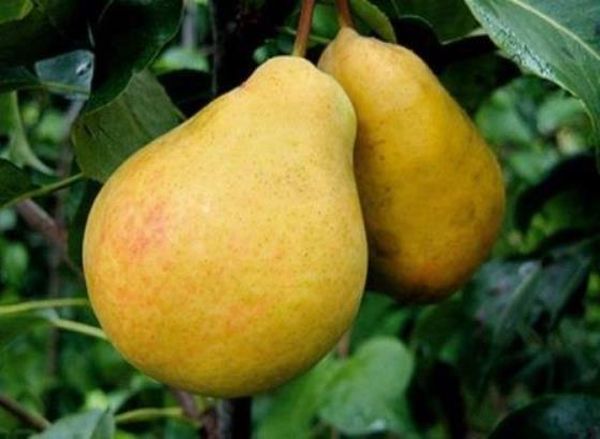
Thumbelina is a variety that ripens in the fall. It was bred in Moscow at the All-Russian Scientific Research Institute of Horticulture and Plant Breeding (VSTISP) by pollinating an interspecific hybrid known as No. 9, or Michurin's Winter Bere, with a pollen mixture from southern species. This mixture included pollen from varieties such as Triumph of Jodoigny, Forest Beauty, Saint-Germain, Anjou Beauty, Winter Dekanka, Duchesse Angoulême, Curé, and Josephine of Mechelen.
The variety's creators are believed to be N. V. Efimova and Yu. A. Petrov. The new variety was submitted for state testing in 1998.
The tree received its fairytale name due to its small stature and small fruits. These two characteristics distinguish Thumbelina from other hybrids.
The tree also has the following characteristics:
- Average early maturity. Fruiting usually begins in the 6th or 7th year of a seedling's life. When planting annuals, the first harvest should not be expected until the 8th year;
- the yield is stable, but not very high;
- Good winter hardiness. This parameter is on par with that of average Russian varieties. Pears can easily withstand temperatures down to -38°C. The trees also respond well to spring frosts that follow a sudden thaw;
- drought resistance is not very high;
- Average immunity. Good resistance to scab and septoria, but is often affected by entomosporium and leafhopper;
- self-sterility.
The harvest ripens simultaneously. The pears are picked in September. The fruits are fairly easy to separate from the branches and may begin to fall off when overripe. With proper care, one hectare of a mature orchard can yield approximately 172–175 centners of fruit.
Once picked, pears can be stored for approximately 1–1.5 months. However, if stored in a cool place (cellar, refrigerator, etc.), the shelf life will increase to a maximum of 113 days. Therefore, fresh pears can be eaten until mid-January.
This variety is most often grown in gardens in the Moscow region and surrounding areas. The hybrid itself is zoned for the Central Region.
This variety is considered a hobby crop, as it doesn't produce a large harvest, and the fruits are small. The harvested fruit is excellent for home canning, making delicious jams, marmalades, candied fruits, compotes, wine, and preserves.
Thumbelina pears are also used in folk medicine, as they promote blood purification and help with menopausal disorders. Regular consumption of these pears has been shown to have a rejuvenating effect, reduce cellulite, and eliminate excess salts.
Video: "Grafting, Pruning, and Caring for a Pear Tree"
This video will show you how to properly care for, prune, and graft a pear tree.
Characteristics of the tree and fruits
To make the description of Thumbelina complete, it is necessary to study in detail the characteristics of the tree and the fruits themselves.
The trees are small in stature and grow slowly. The crown develops slightly drooping and very dense. At any age, the crown remains rounded.
The tree produces numerous branches. The rings, where the fruit is formed, are evenly spaced along them. The stems themselves are short but of medium thickness and are tan-brown in color.
The leaf blade is medium-sized, smooth-surfaced, and its margins are slightly raised. They are characterized by finely serrated teeth. The petioles are equipped with narrow, small stipules.
Pears have the following description:
- small size. On average, they weigh about 60–70 g;
- symmetrical ovoid-pear-shaped. Fruits are wide and short;
- The skin is thin and smooth to the touch. Its surface is almost entirely covered with golden-brown spots. This coloring is considered a characteristic of the variety and is not considered a flaw. The base color of the skin is yellow. The underlying coloring is not pronounced.
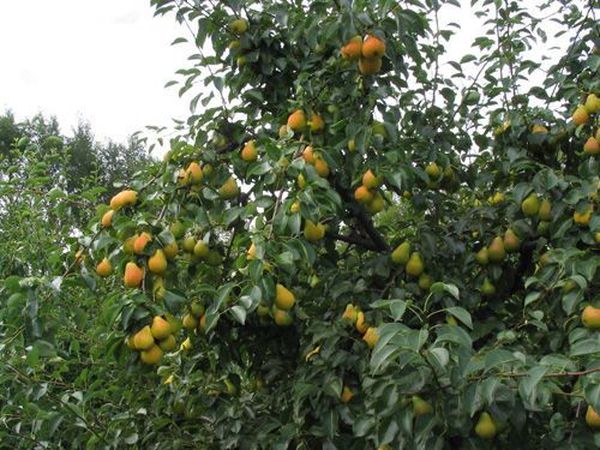
The pears hang on a long, medium-thick stalk. The calyx is small and closed. The seed chambers are closed. The seeds themselves are well-formed.
The pear flesh is creamy, juicy, yet buttery. It melts in your mouth when bitten into. The flesh has a pleasant aroma and a uniquely sweet flavor. It is virtually acid-free, making it a dessert variety.
It is worth noting that the taste of the fruit does not depend on weather conditions.
Advantages and disadvantages
The description of this variety of pear contains the following list of advantages:
- High environmental stability. This is the main advantage of the variety;
- high shelf life of the crop;
- the fruits have excellent taste characteristics;
- the presence of high resistance to certain types of diseases;
- The tree's compact size allows it to be planted even in small garden plots.
Regardless of its advantages, each variety of this crop has its own drawbacks. Thumbelina's disadvantages include a late onset of fruiting and very small fruits. To speed up fruiting, experienced gardeners recommend growing this variety by grafting it onto the crowns of various fruit trees.
As we can see, the Thumbelina pear variety has both clear advantages and specific disadvantages. Therefore, when choosing this variety for growing in your own garden, it's important to weigh the pros and cons. Remember that some disadvantages can be mitigated by a certain approach to cultivation.