
Technology for growing mushrooms in the basement
Content
What should a basement be like?
When deciding how to grow champignons in a basement, the first thing to consider is providing the necessary conditions. As mentioned earlier, growing mushrooms in a cellar or basement is optimal. Some try to grow oyster mushrooms and champignons in a house or apartment, but creating comfortable growing conditions in a living space is virtually impossible. Some mushroom growers resort to planting mushrooms in a brick garage, which can be a good substitute for a cellar.
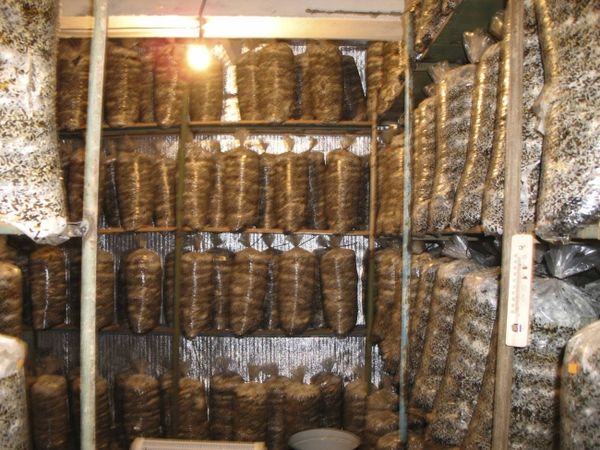
Thus, growing mushrooms in a basement is currently the most cost-effective and least labor-intensive of all the options listed above. However, to obtain a bountiful harvest, you'll need to thoroughly study the cultivation technology for oyster mushrooms and button mushrooms.
Necessary lighting
Growing mushrooms in a basement does not require any sunlight, as mushrooms grow best in complete darkness.
Proper ventilation
Mushrooms in the basement require the right microclimate, which is achieved by constantly maintaining the same ventilation levels, temperature, and so on.
The ventilation system should not consist of open windows and doors that create drafts. Fresh air ventilation may also be insufficient to provide the crop with a constant supply of oxygen. The best option is a forced ventilation system, with metal grates and fine-mesh nets installed over the air vents to protect the plants from rodents and insects.
Humidity and temperature
When growing champignons and oyster mushrooms, it's important to ensure a constant room temperature and high humidity. Champignons and oyster mushrooms are grown in a basement at temperatures ranging from 12 to 27°C and humidity levels of at least 65%.
To maintain the temperature in the basement, a thermometer and a heating system (underfloor heating, heaters) are installed. Since all artificial heat sources significantly dry out the air, humidity will have to be maintained manually, using plastic sheets and a sprinkler.
Zoning
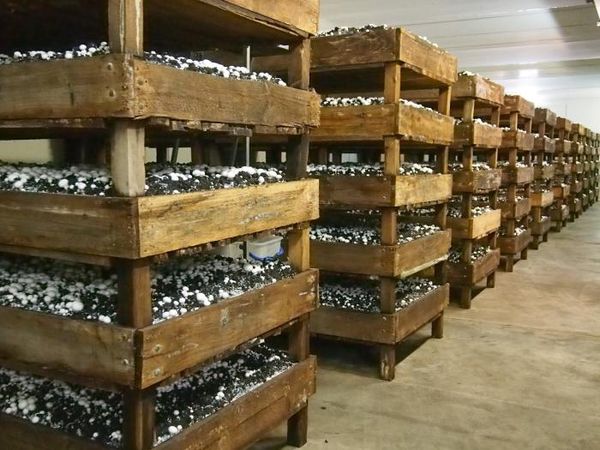
Growing mushrooms in a basement can be done in the most modest of spaces. To save space and accommodate as many plants as possible, it's recommended to build shelving. Metal, plastic, and wood are all suitable materials. However, stainless steel is the preferred choice for metal, and wood should be treated with an anti-rot treatment, which is inevitable in high-humidity conditions.
Sometimes bags, wooden boxes, or wood blocks are used as mycelium storage devices. All of these options are possible, although they are more labor-intensive.
Disinfection
When preparing to grow mushrooms in a basement, the disinfection step is perhaps the most important. Insects and fungal diseases are the enemies of the harvest. High humidity is the main source of all problems. Therefore, if the walls are made of earth or wood, fungal growth is inevitable.
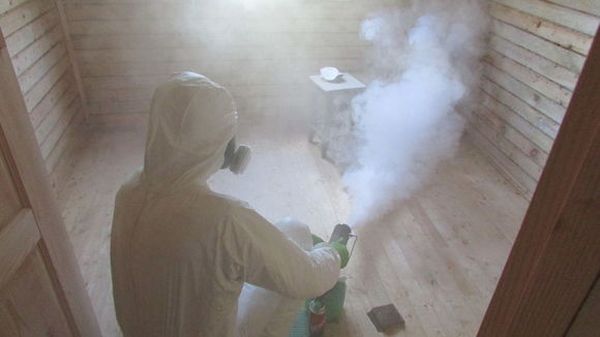
In this case, it's important to ensure the room is as far away from the ground and natural wood as possible. To achieve this, the floors are poured concrete, and the walls are laid out of brick, plastered, and treated with an antifungal solution. The ceiling is whitewashed with a solution of lime and copper sulfate. The entire room is disinfected (for example, with formalin or fumigated with a sulfur candle) before each new planting. All furnishings are also thoroughly treated with antiseptics, and dishes and small parts are boiled.
Varieties for growing
Not every farmer is prepared to grow labor-intensive mushroom varieties. Oyster mushrooms and button mushrooms are considered the best options for home cultivation. However, even among them, there are different varieties.
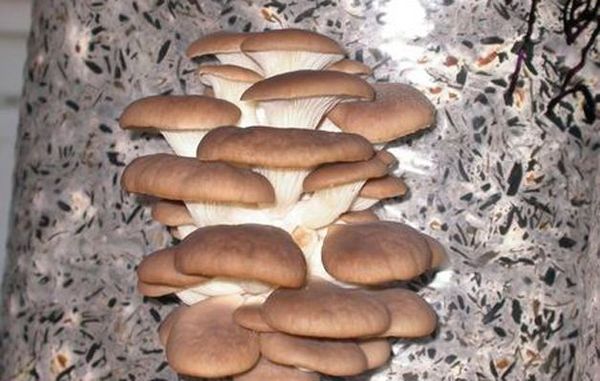
Growing oyster mushrooms offers the opportunity to choose from a variety of "domestic" varieties. These include the Common Oyster, the Oyster Oyster, the Horn-shaped Oyster, the Late Oyster, and the White Elf. Other hybrids also exist, but they differ little from each other. Oyster mushrooms are very undemanding regarding soil and fertilizer, produce large yields, and are resistant to infectious diseases.
Among the champignons, there are a number of hybrids offered by large nurseries and mushroom farms. They differ in size, shape, and color, but are similar in flavor and vegetative characteristics.
Substrate preparation and planting
There are two ways to prepare the substrate: buy it ready-made or make it yourself. Prepare the substrate a month before planting the mycelium, using the following ingredients:
- horse manure (if you don’t have it, then cow or chicken manure);
- straw;
- urea;
- superphosphates and ammonium-containing fertilizers;
- chalk;
- plaster or alabaster.
Horse manure and straw are first disinfected to remove parasites. The straw is then soaked in a warm solution of water and ammonium nitrate for 24 hours. After this time, the straw is layered with manure, moistened with plain warm water, and left for several days, after which the mixture is thoroughly mixed. The remaining ingredients are then gradually added at intervals of 3-4 days, and mixed each time. When the temperature of the mixture has dropped to 25-23°C, the compost is ready for use.
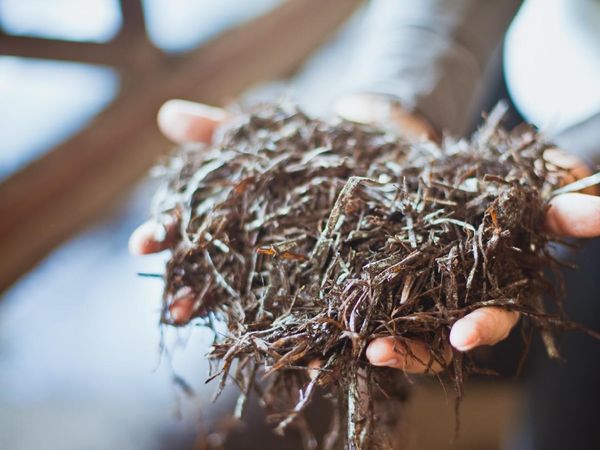
Mycelium is purchased in special stores, where it is grown in sterile conditions.
There are two types of spawn: grain spawn and compost spawn. Make sure it's free of green or black spots when you buy it.
After laying the substrate, you can begin growing the mycelium. To do this, compost mycelium is placed in holes up to 5 cm deep, spaced 15–20 cm apart. The placed mycelium is covered and watered. Grain mycelium is simply scattered over the surface of the substrate.
Care and cultivation
During the development of mushroom threads, the optimal temperature is 22–27°C; after they appear, it drops to 12–15°C. The first mushroom threads appear two weeks after planting, after which the planting surface is covered with a mixture of peat, leaf mold, and limestone (5:4:1).
Mushrooms thrive in moisture, so they are misted every 3-4 days for the first two weeks. To do this, cover the surface of the substrate with plastic and mist it with warm water. After this point, it's best to reduce the frequency of misting to prevent the mycelium from rotting.
Harvesting
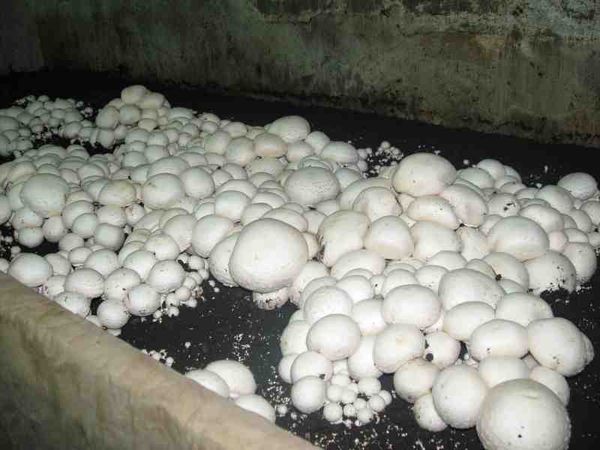
The first harvest will begin 12–16 weeks after planting, and regular fruiting will continue for the next 10–16 weeks. After each ripening, the mushrooms are carefully twisted out and replaced with a thin layer of soil. After each harvest, the substrate is watered with a solution of water and superphosphate.
Video "Mushroom Growing Technology"
This video will teach you how to grow mushrooms at home.