
Tips for mushroom pickers: what the summer honey fungus looks like and where it grows
Content
- 1 Description of summer honey mushrooms
- 2 Video: "What You Need to Know About Summer Honey Fungi"
- 3 Distribution area
- 4 Similar false and dangerous species
- 5 Is it possible to grow summer honey mushrooms in a garden?
- 6 Season and features of summer honey mushroom harvesting
- 7 Primary processing and preparation
Description of summer honey mushrooms
The summer honey fungus is an edible member of the Strophariaceae family. It shares a general resemblance to other honey fungi, but has some distinctive features. The cap is smooth and slippery, 3-6 cm in diameter, initially convex, but flattens with age, with a hump in the center.
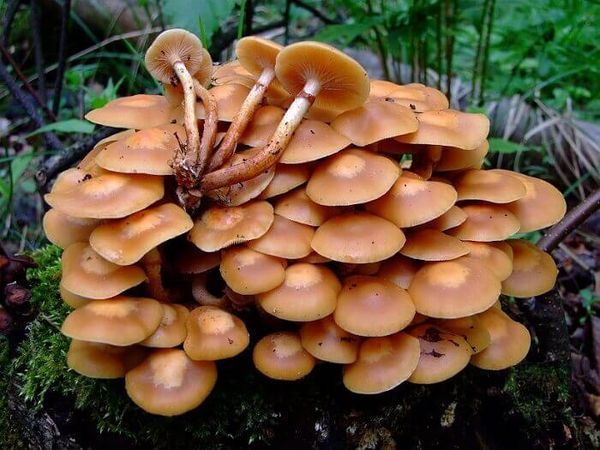
The coloration is zoned: a brown center, followed by a yellowish stripe, and a brown border along the edge. In dry weather, the color fades, but with increasing humidity, the brown becomes more pronounced. The gills are sparse, fused to the cap. The stem is thin and tall (up to 8 cm), fibrous, with the characteristic ring of honey mushrooms and dark scales at the base.
Summer honey mushrooms are classified as Category 4. This means they are not only edible but also have good nutritional qualities. As with all honey mushrooms, the cap is considered the most tender and delicious part; the stem is tougher.
Video: "What You Need to Know About Summer Honey Fungi"
In this video, an expert will talk about a popular mushroom: the summer honey fungus.
Distribution area
Summer honey mushrooms, like autumn ones, grow in clusters on wood debris: old stumps, logs, and damaged trees. They prefer deciduous trees but can also grow on conifers. These mushrooms are native to mixed forests in temperate climates. They are sometimes found in small plantings and even in home gardens. They prefer a cool, humid climate, so they produce large quantities of fruit in difficult-to-reach places.
Mushrooms accumulate harmful substances from the environment, so it is not recommended to collect them within large cities, as well as near highways, landfills, and industrial plants.
Similar false and dangerous species
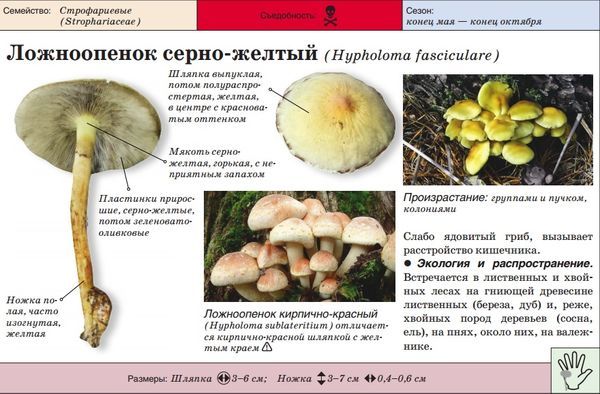
The summer honey fungus has many lookalikes that are poisonous and dangerous to humans:
- Galerina marginata is a highly poisonous mushroom, causing severe poisoning, liver damage, and even death. The mushroom's distinguishing features are its reddish cap with a yellow border and a scaleless stem. It emits a floury odor. It grows in coniferous forests and does not form colonies.
- Psathyrella is a conditionally edible variety with an unpleasant, bitter taste. The cap is bell-shaped, later becoming flat. The surface is dry and brownish. The stem is curved and mealy.
False honey mushrooms are a group of poisonous mushrooms, represented by the following varieties:
- gray-yellow mushroom - the cap is yellowish-brown with a light edge, the stem is sunken, it emits a pungent odor;
- gray-lamellar - the cap is gray, hemispherical, becomes flattened over time;
- brick-red - a mushroom with a large (up to 10 cm) reddish cap with a dark spot on the top;
- watery - the cap is bell-shaped, cream or brownish in color, the stem is pale.
Is it possible to grow summer honey mushrooms in a garden?
You can grow honey mushrooms yourself if you have old stumps or at least log sections left on your property. Mycelium (pieces of bark infected with spores) is transferred from a real mycelium or purchased from a store. Holes 0.8-1 cm in diameter are drilled in the stumps, the mycelium is transferred, and the holes are sealed with moss. The soil around the stump is regularly moistened, and the stump itself is covered with branches to maintain moisture.
The process can be carried out on logs year-round, as the required temperature can be easily maintained by moving the logs to a basement or greenhouse. The initial mycelium harvest is modest, but by the following year it increases three to fourfold. Under favorable conditions, mycelium fruiting lasts for four to seven years.
For commercial purposes, mushrooms are grown on sawdust. To improve the structure and increase nutritional value, they are mixed with wood shavings in a 2:1 ratio, and starch, oatmeal, or bran are added. This mixture is doused with boiling water, after which the mycelium is added. The containers with the substrate are then placed in a cool, damp place away from light, and after 2-3 months, they are brought into the light, where fruiting begins.
Season and features of summer honey mushroom harvesting
The summer honey mushroom harvest season begins in late spring and lasts until early November. In areas with a mild climate and high humidity, fruiting is possible year-round. Mushroom maturation occurs in waves. They appear in large numbers within a few days of rain, but also thrive in damp, cool conditions. It's best to harvest honey mushrooms early in the morning. Cut the mushrooms carefully, just above the ground, being careful not to damage the mycelium.
Summer honey mushrooms contain a lot of moisture, so it's best to collect them in baskets rather than bags, otherwise the entire harvest will turn into a caked lump.
-
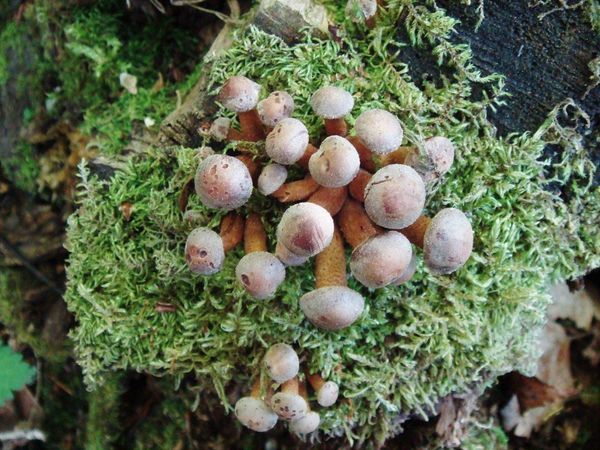
- It is better to collect honey mushrooms early in the morning.
-
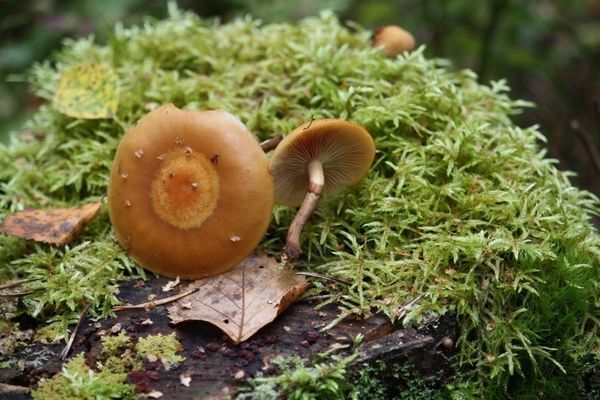
- The season for collecting summer honey mushrooms begins in late spring.
-
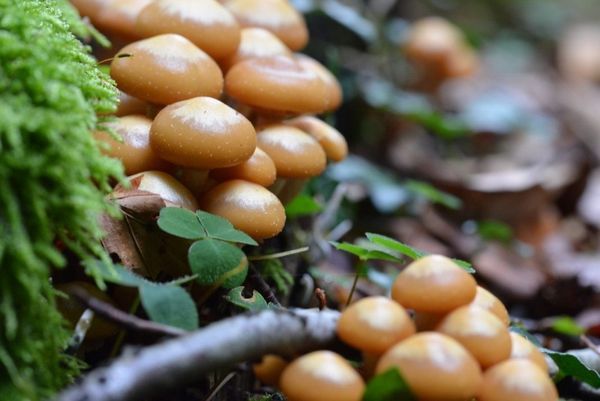
- Summer honey mushrooms contain a lot of moisture
Primary processing and preparation
Since the mushroom is edible, it can be cooked without pre-boiling. If you harvested it from your own garden, simply wash it thoroughly. Wild honey mushrooms should be rinsed under running water several times to remove all plant debris. After this, you can use any cooking method: frying, stewing, pickling, or marinating.
Honey mushrooms' flavor is best enhanced when salted or pickled. To do this, they are first boiled and then prepared according to the recipe.
The product can be frozen either cooked or raw. Dried, unwashed honey mushrooms are used for drying. Dried mushrooms can be used to make homemade mushroom powder for sauces and soups.
Summer honey mushrooms are a healthy and affordable product that can be used to prepare a wide variety of dishes and preserves. The key is to be able to distinguish them from their dangerous lookalikes. But you can avoid these mistakes by growing them in your own garden.