
Preparing spring garlic for spring planting
Content
Spring planting rules
Experienced vegetable growers say there are only two basic rules for spring planting of garlic:
- do not rush with planting;
- Don't be late for boarding.
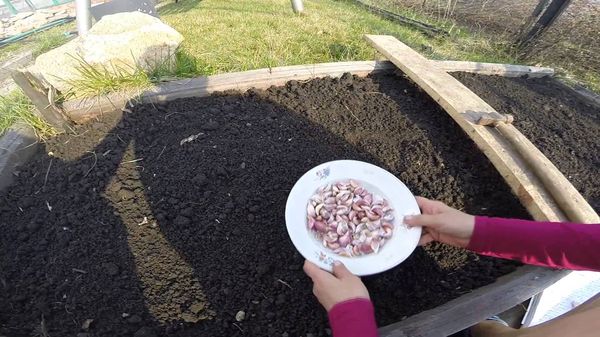
As strange as it may sound, it's true. Garlic is a cold-hardy crop and can withstand low temperatures, but if you plant it in cold soil, you'll have to wait a long time for sprouts to emerge, which will be weak and slow-growing. At the same time, planting garlic late can prevent fully ripened bulbs, meaning they won't store well. Winter garlic bulbs are typically much larger than spring garlic, but spring garlic can successfully store for two years. The only requirement is that the garlic must be fully ripe and stop growing before harvesting. So, planting timing is truly crucial.
To determine the correct planting time, you need to know the approximate summer and fall seasons in your region. The best time to plant is when the soil still retains moisture from the melting winter snow, but has already warmed to 5 to 8 degrees Celsius. If September is warm in your area and the first frosts don't arrive until the second half of October, you can take your time planting and wait until the second or third week of April. You can water the soil before late planting garlic, but make sure you allow enough time for the crop to ripen.
When preparing a bed for this spicy vegetable, remember crop rotation rules. It shouldn't be planted after onions, cucumbers, or carrots, and garlic can only be planted in the same spot after three years. It's best if the plot previously contained cabbage, cauliflower, white cabbage, peas, and beans.
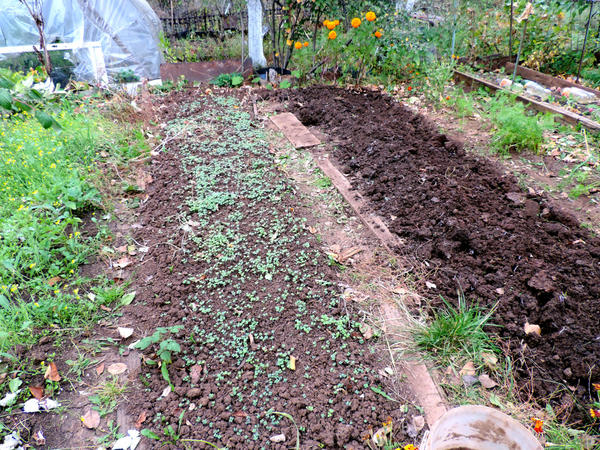
For spring planting, especially early ones, the plot should be prepared in the fall. Dig it over, remove the roots of perennial grasses, and add humus or compost, superphosphate, and potassium fertilizer. Garlic prefers nutritious, breathable, non-acidic soil. Therefore, there's still time to adjust the soil structure and acidity in the fall. Sand and wood ash are added to heavy clay soil, while lime or dolomite flour is added to overly acidic soil.
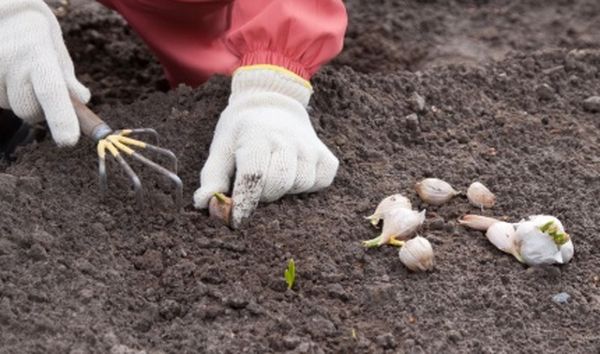
Processing cloves before planting
Pre-plant garlic treatment is required for both winter and spring garlic. However, before planting spring garlic, all planting material must undergo stratification. To do this, remove it from storage in advance, inspect it briefly without disassembling the heads, and then place it for a month in a location where a stable temperature is maintained between 3°C and 6°C. The bottom shelf of the refrigerator is ideal for this.
This cooling for 3-4 weeks will speed up the growing process. After stratification, the garlic will begin growing sooner, once it's in suitable conditions. Furthermore, it will definitely stop growing in August. Without stratification, the garlic may well turn green with the arrival of autumn, growing until the frost, but the bulb will continue to grow, meaning it won't ripen. This garlic doesn't keep well over the winter, let alone for two years.
The planting material is removed from the refrigerator a day before planting. It is separated into cloves and carefully inspected, discarding any specimens with the slightest hint of rot or mold. Moreover, if a moldy clove is detected, the entire head should be discarded. Good planting material is distinguished by an even gray base and healthy, fleshy cloves that are not overdried. There is no need to peel the cloves; this will provide additional protection once the garlic is in the ground.
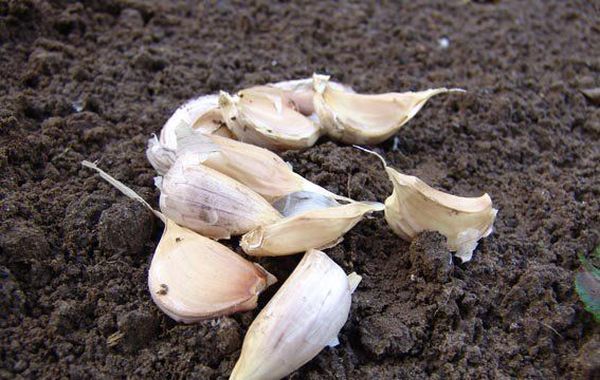
It's essential to sort the cloves by size. Planting material of approximately the same size promises equal germination, meaning such plantings won't shade each other. Plant material of the same size in a single bed. Only the outer cloves of spring garlic are suitable for planting heads.
Everyone has noticed that its heads consist of several layers of cloves, unlike winter cabbage. So, only those that form the outer circle should be selected. The smaller inner cloves can be eaten or planted for greens. For greens, they must be planted separately.
Selected cloves should be treated with potassium permanganate. To do this, soak the garlic in a pink solution of potassium permanganate and leave it overnight, or even for a day. Some gardeners prefer soaking it in a copper sulfate solution, while others alternately soak the garlic in one solution, then the other, for short periods. Just before planting, remove the cloves from the potassium permanganate (or copper sulfate) solution and soak them for a few minutes in salt water. To do this, dissolve 1 tablespoon of table salt in three liters of warm water.
These are the steps taken before planting spring garlic. You can simply disassemble the heads and place the dried cloves in the soil without any pre-treatment. However, this increases the risk of garlic becoming infected with various diseases, particularly fungal ones; even some pests tend to infest garlic bulbs. Therefore, most gardeners prefer to take the time to prepare before planting rather than worry about saving the harvest later.
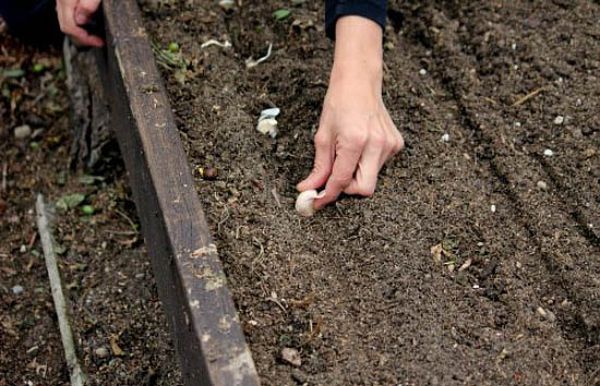
Soil preparation
Garlic grows best in fertile loams that allow air to reach the roots, don't retain excess water, but also don't dry out too quickly, as garlic thrives on moisture. If the soil is suitable, it's easy to prepare (clean, till, and fertilize) in the fall. Then, in the spring, all you have to do is loosen the moist soil from the snowmelt and begin planting.
But not everyone is blessed with such good soil, so those with heavy (or, conversely, overly sandy) soils are forced to care for their plants themselves. Garlic doesn't have very long roots, so in unsuitable areas, gardeners create raised beds, bringing in or buying specialized soil, vermicompost, and all the necessary fertilizers. But you can prepare the soil without spending extra money; you just need to take care of it in advance.
Gardeners typically make their own compost, since plant waste is produced annually. If you have access to chicken manure, cow manure, or even better, horse manure, vegetables grow beautifully. You can also prepare a very convenient bed for garlic by covering the selected area with mown grass or weeds. Top it with soil, compost, peat, and sand, and water it with mullein infusion if needed. By spring, you'll have a beautiful bed that will warm up faster, retain heat better, and thus accelerate vegetable growth.
In the spring, nitrogen fertilizers are added if needed. These include humus, compost, urea, or wood ash, which is usually added at the same time as planting. If the soil has already dried out, water the furrows or holes. Many people water the soil with salt water or a potassium permanganate solution.
Planting in the ground
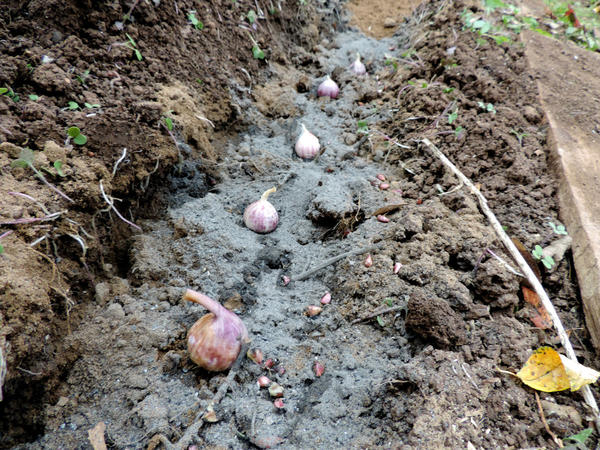
In the prepared beds, make furrows at intervals of 15-20 cm. The bottoms can be sprinkled with wood ash. If the soil has dried out, water the furrows and let it soak in. Then, plant large cloves every 10-15 cm, planting them no more than 2.5 times their height (the height of the clove), covering them with soil, and then lightly compacting the soil with your hands or a tool so that the cloves aren't pressed into the soil, but are simply pressed firmly into the soil.
If planting material is placed in holes, depending on the soil quality, they can be made large (up to 25 cm deep and up to 10 cm wide) or only to the planting depth. Deep holes are filled with prepared fertile soil. If necessary, water is added to the holes, wood ash is added, then the cloves are placed and covered with soil. The soil should be loose at the time of planting and free of large clods or stones. It should also be pressed down lightly, without disturbing the garlic.
It's best to plant different-sized cloves in separate beds. Smaller cloves can be spaced closer together, and those planted for greens should be placed almost next to each other. Leaving too much space between plants will cause the soil to dry out faster and encourage weed growth, but they shouldn't be placed in such a way that they interfere with each other; moderation is key.
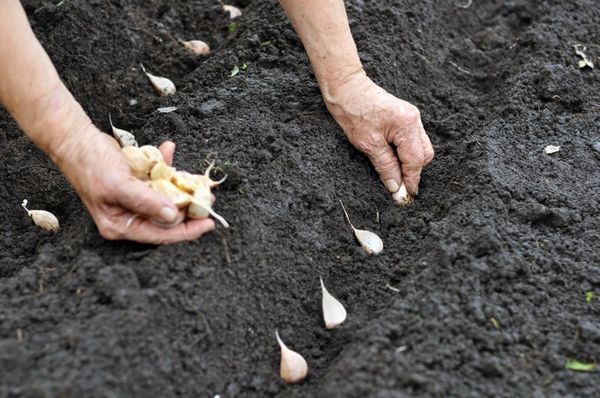
After planting, it's a good idea to mulch the bed with sawdust or hay. This will retain heat and moisture in the soil, avoid disturbing the plantings with watering and loosening, and prevent weeds.
Post-planting care
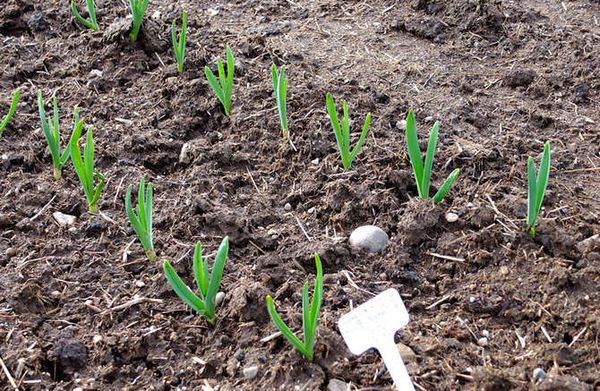
If the preparation of the seedlings and the planting itself were done correctly, and the weather didn't throw up any nasty surprises, the beds should be greening up nicely within two weeks. It's generally believed that the emergence of seedlings is a good time to fertilize the beds with nitrogen-containing fertilizer, such as a solution of chicken manure infusion. Each homeowner decides the appropriateness of fertilizing based on the degree of soil preparation before planting and its fertility.
Regardless, garlic responds well to organic fertilizers. Just remember that nitrogen stimulates foliar growth, so nitrogen fertilization should only be carried out until mid-summer; it's even better to stop by the end of June.
When caring for garlic, a gardener must remove weeds, monitor soil moisture, fertilize, and inspect for fungal or viral diseases in order to take timely action to eliminate them.
Summer typically brings a period of dry heat, requiring regular watering of the beds. This is done in the evening, and the next day, the soil is loosened to prevent crusting and weeding. Watering is stopped when the heads have reached their maximum size; excess moisture beyond this point can prevent them from ripening or even cause rot. Watering is typically stopped in August, but the exact timing varies by region.
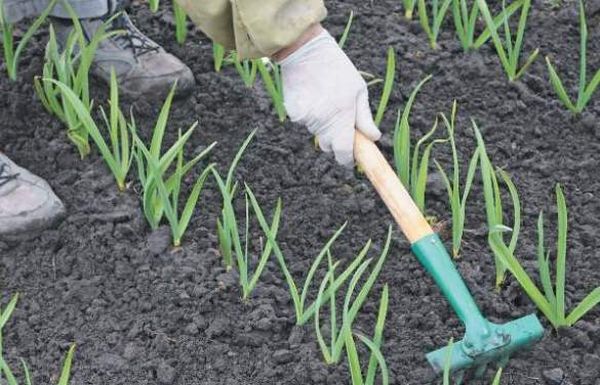
Fertilizers are applied simultaneously with watering or scattered between the plants. Nitrogen is applied until the end of June, and then only phosphorus and potassium are applied. Avoid overdoing it with fertilizer, as excess fertilizer can accumulate in the bulbs and eventually end up on our tables. If the soil is properly prepared before planting, fertilizers may not be needed at all, or only minimally.
If weather permits, don't harvest immediately, once the leaves begin to yellow and fall to the ground. By September, the garlic is already ripe and won't grow any further, but if it remains in the ground until mid-October (or at least early October), the harvest will keep better. Just be sure not to let it freeze in the ground.
Harvesting is best done on a cool, dry day. Garlic is removed from the soil by hand or with a tool (shovel, pitchfork), left directly in the garden bed to dry, then cleaned of soil and hung or laid out to dry before storage.
Video: Preparing Spring Garlic for Planting
This video will show you how to properly prepare spring garlic for planting in the spring.