
When and how to plant garlic in spring
Content
Features of spring planting
Garlic is a bulbous perennial plant that is grown as an annual. Its varieties are divided into winter and spring varieties. When planting garlic in the spring, you should purchase bulbs of spring varieties.
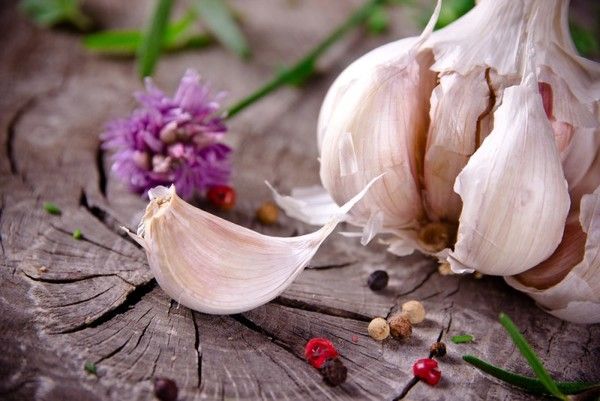
Here are their differences:
- The bulb lacks a central stem. This plant does not produce a stalk with aerial bulblets, but propagates only by cloves (the Gulliver variety is an exception).
- The small heads consist of numerous (up to 30) small cloves growing in a spiral.
- Spring garlic is inferior to winter garlic in terms of yield, but it can be stored for much longer, practically until the next harvest.
- You can start planting as soon as the soil has warmed up to 5-6 degrees, which usually happens in April.
Spring thyme develops roots and leaves when temperatures do not exceed 10 degrees Celsius and the soil is moist. When temperatures reach a steady 15 to 20 degrees Celsius, the plant devotes all its energy to bulb formation. At temperatures above 20 degrees Celsius, bulb growth ceases and ripening begins. Delayed planting will negatively impact the yield.
Soil preparation
The plant has a weak root system, which is located in the topsoil. Therefore, the fertility of this layer is critical for a good harvest.
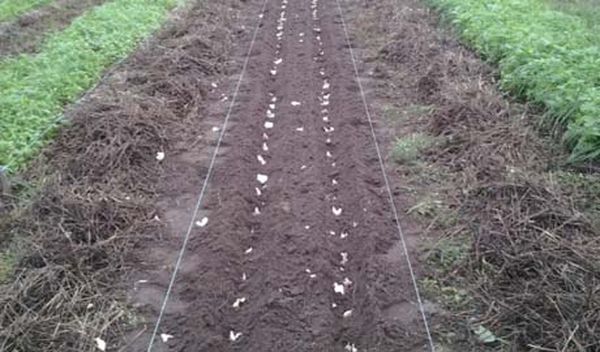
It's best to prepare the bed in the fall by digging it and adding 0.5 buckets of rotted manure or compost per square meter. Ash or 10-15 grams of complex fertilizer should also be added. The site for this bed should be well-lit and protected from north-facing winds. In flooded lowlands, the plant is planted in raised beds.
Preparation of planting material
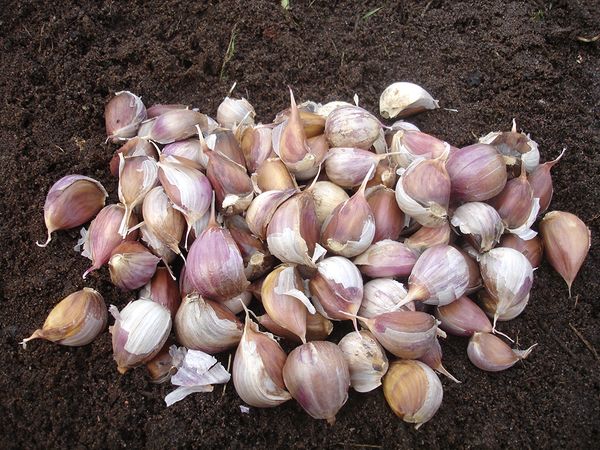
You need to separate the garlic heads into cloves before planting so that the bottom from which the roots grow does not dry out. Only large cloves growing outside the bulb are suitable for planting. To accelerate root formation, the vigorous development of which is essential for growing large bulbs, the selected cloves must be properly prepared before planting. First, soak them for 2 hours in a weak solution of potassium permanganate or ash. This not only provides moisture but also protects the planting material from potential diseases. After this, place the cloves in a plastic bag and place them in the refrigerator or cellar for several days. If planting is a tight deadline, the plant can simply be soaked in the solution for 6-8 hours. nitroammophoska (5 g on 10 liters of warm water).
Planting in the ground
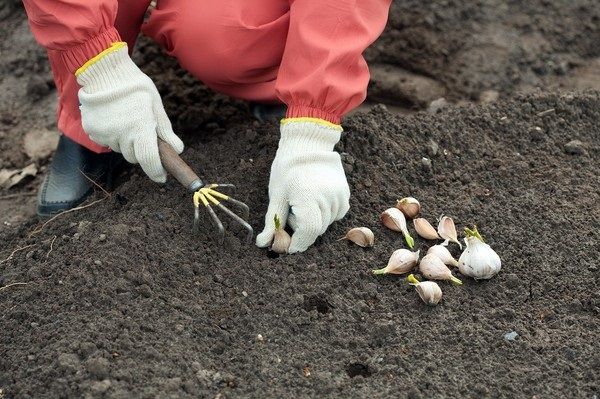
Garlic is planted in rows, spaced 10-12 cm apart. Rows are spaced 20 cm apart. The cloves are planted 5-6 cm deep. When planting, it's crucial not to damage the newly formed roots, so don't press the cloves into the soil. It's best to make holes with a stick or a sealed tube of the appropriate diameter. Once all the holes are filled, level the soil. Water the bed after planting only if the soil wasn't sufficiently moist.
Watering and fertilizing
Regular watering is essential during the growing season. After six leaves have formed, bulbs begin to form, and the frequency of watering should be reduced. After mid-August, watering is completely unnecessary, as moisture during this period delays bulb maturation and reduces the accumulation of nutrients. After the shoots emerge, it's best to mulch the garlic beds; this reduces moisture evaporation and inhibits weed growth. Unmulched beds should be loosened after each watering. After the first leaves appear, apply nitrogen fertilizer. It's best to use organic matter—a 1:10 solution of rotted cow manure or bird droppings 1:12 AM June-early In July, when the bulbs are formed, fertilizing is carried out potassium-phosphorus Complex fertilizers. The fertilizer should be applied in liquid form and only after watering.
Is it possible to plant winter garlic in spring?
Don't throw away any excess winter garlic left over from the winter. It can be planted in the same way as spring varieties. Germination should begin a month before planting. Soak the cloves for 7-8 hours in any stimulating solution, then wrap them in a damp cloth, place them in a plastic bag, and refrigerate. Keep the bag slightly open, and moisten the bag periodically. After a month, the roots will grow 5 cm long, and the garlic is ready to plant.
Make a wide furrow in the soil, 5-6 cm deep, place the prepared cloves in it, and cover with soil. The top of the planting can be mulched with humus. Further care is the same as for spring garlic. In the summer, when the stalks form, leave 5-6 cloves to monitor maturity. bulblets When they ripen and the shell around them bursts, the garlic can be dug up.
Garlic is a very important crop, as it's included in almost every recipe. If you didn't plant garlic in the fall, you can plant it in the spring and guarantee a good harvest.
Video: Planting Garlic in Spring
This video will show you how to properly plant garlic in a garden bed in the spring.