
Growing the early-ripening watermelon Sugar Baby
Content
Necessary conditions for growing
The early-ripening "Sugar Baby" watermelon is easy to grow. The variety description emphasizes that it is suitable for cultivation in central and central Russia, the Volga region, and southern regions, where the climate allows the watermelon to fully ripen and accumulate sufficient sugars in the pulp. With seedlings and partial shelter, it can also be grown in Siberian climates. However, it should be noted that the lack of sunlight can cause the pulp to be slightly tart or too watery.
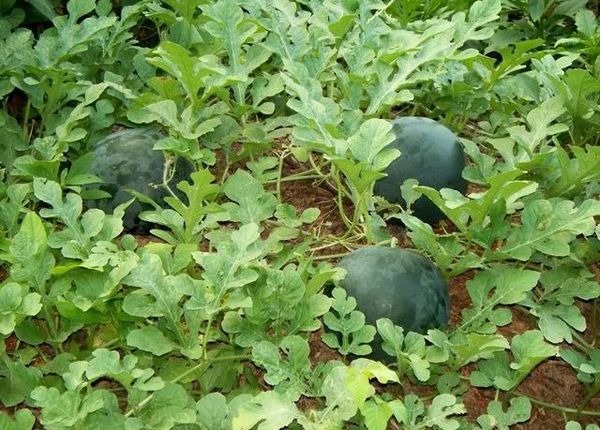
Like all melons, Sugar Baby watermelon thrives in warm weather. It thrives in sunny, wind-free areas with light, fertile sandy or sandy loam soil. Thanks to its deep root system, the plants easily tolerate drought and produce high yields—10–12 kg/m². Watermelon care consists of the following steps:
- Water the roots as the soil dries. Frequent watering is not necessary, as excess moisture will reduce the sugar content of the pulp;
- removing weeds before the plants become untidy;
- regular loosening of the top layer of soil;
- pinching lateral shoots and removing excess ovaries.
Watermelons of the Sugar Baby variety are not particularly large, and in order for them to reach their maximum weight on one bush, no more than 3 ovaries should be left. It's best to have these ovaries on the main shoot—this will allow the plant to be formed into a single stem. Once the ovaries appear on the bush, the tip of the main shoot and all side shoots should be pinched off.
The plants are growing vigorously. Within a month, flowers appear, and soon, ovaries set. During this period, night frosts are still possible, and if the plants are not provided with cover, the entire harvest can be lost. Covering the bed is also necessary if the summer rains are prolonged. Excessive moisture can lead to root rot, disease, and, during the active ripening period, cracking and a decrease in flavor.
Features of sowing
Sugar Baby watermelons can be grown in two ways: by sowing directly into the ground or by using seedlings. Both methods are successfully used for propagation on both private and commercial farms. The choice depends on the region's climate. In the south of the country, where springs are early and summers are warm and dry, planting can be done directly into the ground without the risk of frost. Sowing should be done no earlier than when the soil at a depth of 10 cm has warmed up to a temperature of 15–18 °C.
In the Moscow region, as in the rest of the central part of the country, it's best to grow watermelons from seedlings, as they don't tolerate cold nights well. Seeds should be sown approximately a month before transplanting into the ground. By this time, the plants should have developed 2-3 true leaves, and daytime temperatures outside should be at least 20-25°C. In the Moscow region, this typically occurs in early June, so seeds for seedlings should be sown in early May.
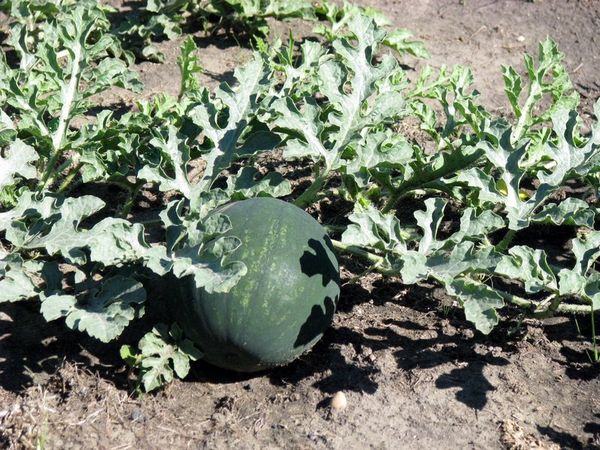
In Siberia, it is recommended to grow watermelons from seedlings and under cover. This can be either a permanent greenhouse or a plastic structure that is removed when the weather warms up. To save space in greenhouses, watermelons can be grown on supports. In this case, plants are planted 70 cm apart. When grown outdoors, the distance between plants should be increased to 1 m.
Watermelon seeds have a very hard shell, so they need to be germinated before planting. First, the seedlings are disinfected in a potassium permanganate solution, then placed in a wet cloth until they open (sprout). The sprouted seeds are planted in moist soil at a depth of 3–5 cm. In well-warmed soil, seedlings appear in 5–7 days.
Top dressing
Fertilizers are crucial for watermelon yield, but given the crop's short growing season, fertilizing should be done with caution. Since fertilizer application is no longer recommended a month before harvest, it is essential to add organic matter and mineral fertilizers (phosphorus, potassium, magnesium, and nitrogen) during soil preparation. Fertilizers are then applied during fruit set, immediately after flowering, and before fruit ripening. Liquid fertilizers applied to the roots are preferred for Sugar Baby watermelons: liquid manure or litter, herbal infusions, or ash solutions.
Pros and cons
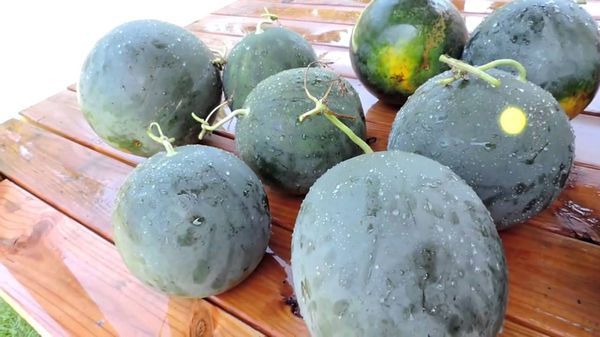
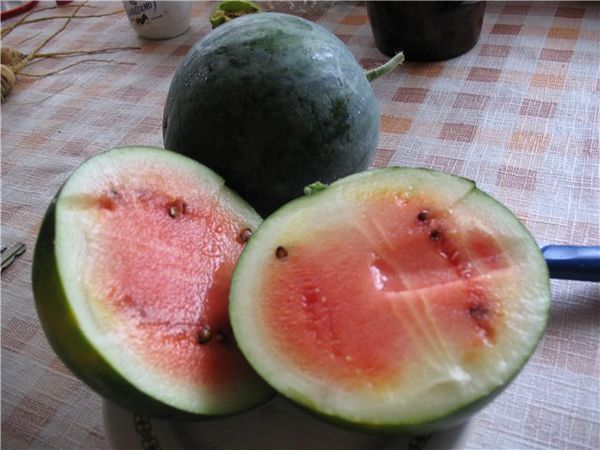
Judging by reviews from gardeners and homesteaders, the Sugar Baby watermelon has virtually no shortcomings: it grows and produces fruit well in any climate, and its taste is comparable to imported watermelons grown in the south. Furthermore, the variety ripens very early, is easy to care for, is resistant to diseases and other negative factors, and the fruits are easy to transport and can be stored for about six months.
Video: "Saving a Watermelon for New Year's"
This video will show you how to preserve a watermelon until the New Year holidays.