
How to grow a watermelon at home on a windowsill
Content
Which variety to choose?
ToIt's best to grow a watermelon at homechoosesmall-fruitedand early ripeningvarieties,which are also used for growing in greenhouses.Their fruits are small with a thin skin.ozhuroy.In addition to excellent taste, such varieties are quite resistant to diseases..Please note in advance that watermelon is a light- and heat-loving crop.
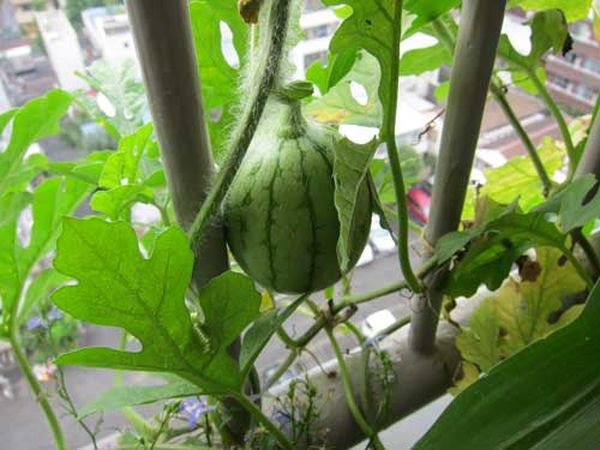
To ingrow upwatermelon in the apartmentor loggias where there is little light,Those varieties and hybrids that are less dependent on light levels are suitable. In general,The following varieties are suitable for growing at home: "Kakho", "Gift to the Sun", "Honey Lazybones", "Ogonyok", "Siberian", "Rose of the South-East", "Volgar".A watermelon of one of these varieties could easilytgrownHouses.
Necessary conditions
In that,How to grow a watermelon on a balconyor at home, there are some nuances.Togrow upwatermelon, the southern, sunniest side is best (direct sunlight is good for watermelon). In some cases, western or eastern windows may be suitable, but not northern ones.grow upA delicious watermelon will require at least 12–14 hours of daylight. Insufficient natural light can be compensated for with fluorescent or LED lamps, as well as phytolamps.
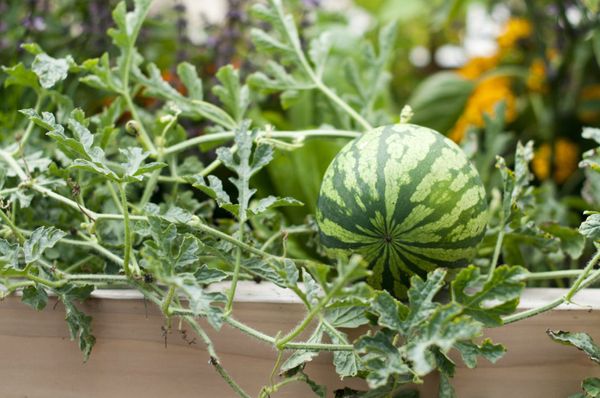
In cloudy weather they can be left on all day.With their help, the problem is also solved.ask "Is it possible to grow a watermelon?at home in autumn or winter."In cold weather, it is better to place the plant near a radiator.On growing on the balconyIt is best to eat watermelons in the summer.
The optimal temperature for growing watermelons should be 25–30°C during the day and at least 18°C at night. This is especially important during fruit set.
Watermelonbestis growingIn loose, fertile soil with a neutral pH. You can buy nutrient-rich soil at the store or prepare it yourself. To do this, use 1 part each of sand, humus, and turf soil, plus 1/10 part fine wood ash. To disinfect the soil, you can microwave it for 10-20 minutes, steam it in a double boiler (approximately 1.5-2 hours), or pour boiling water over it.
Sowing seeds
WITHThe seeds should be large and free of damage or defects. To prepare for planting, soak them in a 5% solution of table salt—this will help identify empty seeds. It's also recommended to soak the seeds in a weak solution for 10–15 minutes.potassium permanganate. PAfter this, the seeds can be soaked in a damp cloth or sand until they sprout.
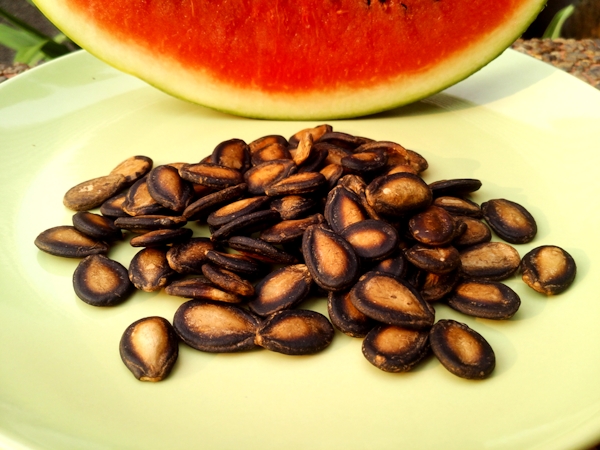
The seeds can be planted in seedling cups.possiblealso plantstraightawayinto the container in which they will grow permanently,but in this case, you will need to carefully monitor watering: the soil, not yet covered by the root system, may become acidic, which will subsequently cause disease and death of the plant.The seeds should be planted at a depth of approximately 2 cm, 2-3 in one pot.After the first leaves appear, weak plants should be discarded, and strong ones should be transplanted to a permanent location -Place the plant in a special planting box, bucket, basin, or large flowerpot (it's important to choose an opaque one, otherwise the roots may dry out). The container should hold 10–15 liters or more.
Features of cultivation
Ethere are severalimportant tips regardingTogo,How to grow a watermelon at homeconditions and get a tasty fruit.Since watermelon is a very light-loving plant, grow a watermelonwill helpsteamAreflective screens that will provide the plant with uniform lighting. As the vines grow, they should be tied to the support with soft, wide ribbons.correctformationsplants, especially if there is not much space, remove peripheral loops.

Experts' opinions on watering often differ. Some insist onthatgrowing watermelons at home requires abundant wateringOthers believe that watering can be limited or even stopped completely during the ripening period, as water isn't necessary for the fruit's sugar content. In any case, it's recommended to water the seedlings as usual, as needed, and then proceed based on the situation and experience.
When the plant develops three true leaves, you can begin fertilizing with complex mineral fertilizers containing potassium, nitrogen, and phosphorus (preferably in equal proportions). A second fertilization is performed during fruit set, with a higher potassium and phosphorus content. The third fertilization is usually done 2-3 weeks later. As the watermelon grows, it's a good idea to lightly loosen the soil in the container.
Flowering and fruit formation
In about two monthsindoor The watermelon begins to bloom: first the male flowers appear, then the female ones(they can be distinguished by their rounded stalk)Since there are no natural pollinators indoors, fertilization can be doneBy simply touching the flower to the flower or with a soft brush. Before this, female flowers can be treated with a special stimulant.
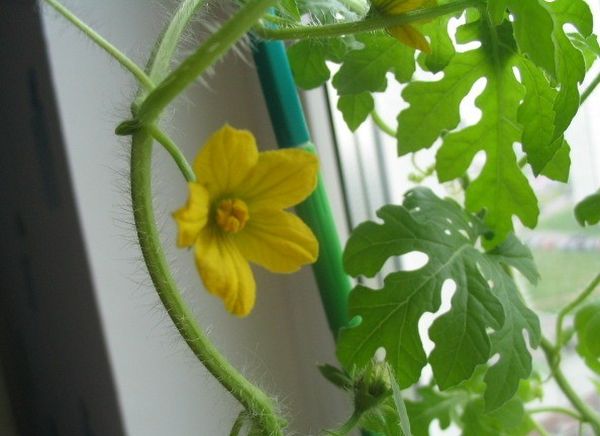
When watermelons begin to grow, select 1-2 and remove the rest. To prevent the plant from breaking under its own weight, the fruits should be placed in a net and tied to a trellis or laid on the ground, with boards underneath (otherwise they may rot). For a fruit to ripen, it needs 11 leaves; it's best to remove all the remaining leaves, as well as the top of the vine. It takes about a month from fertilization to ripening. A ripe watermelon can be identified by a dried-out stem; when tapped, it makes a ringing sound. As you can see, it's not soalreadyIt's hard to grow watermelons on a windowsill!
Video "Watermelons on the Balcony"
In this video, you will hear useful tips on growing watermelons at home.