
How to properly plant watermelons in open ground and a greenhouse
Content
Soil preparation
Clearly, soil preparation is a crucial step in growing this plant. After all, this is the environment in which the plant will develop until fruiting. But first, a few words about selecting and preparing the seed. First, choose the right variety or hybrid suitable for your climate. Hybrids are usually already treated with fungicides and therefore do not require the seed preparation described below.
Before sowing, place the watermelon seeds in cheesecloth and soak them in a warm solution of potassium permanganate. Place this container in a plastic bag and place it indoors at room temperature. Change the solution daily. Preparing the seeds doesn't take much time. In just a couple of days, you'll see the seeds sprout—this is a sign they're ready to be planted in the ground.
Plant this plant in a warm, well-lit spot. Watermelon requires sandy loam or sandy soil. It’s good if onions, cabbage, and legumes were planted in this area before the watermelon.
As for the soil, its preparation involves the following steps:
- It is better to enrich the soil with compost in the fall so that it will be fertile next year;
- Before planting in the soil for watermelons, it is worth adding potassium, phosphate fertilizers and ammonium sulfate in a proportion of 20:40:30 g per 1 m²;
- The soil needs to be loosened and the beds prepared in advance.
Seedling method
This method is ideal for growing this plant in areas with short, cool summers. To plant watermelons using seedlings, select high-quality seeds from early hybrids. Keep in mind that seedlings should not be planted for another 25 days after germination. The seeds should be sown in April. How to properly plant watermelon seeds for seedlings? For watermelon seedlings, use special peat or plastic cups, into which one seed is planted at a time.
You can buy watermelon soil at the store or make your own. To do this, mix equal parts humus, peat, sand, and soil, adding wood ash. Incidentally, this mixture is suitable for all members of the Cucurbitaceae family. Place the seed a couple of centimeters deep in the moistened soil mixture. Place the cups under plastic film. Once the seedlings emerge, the film is no longer needed.
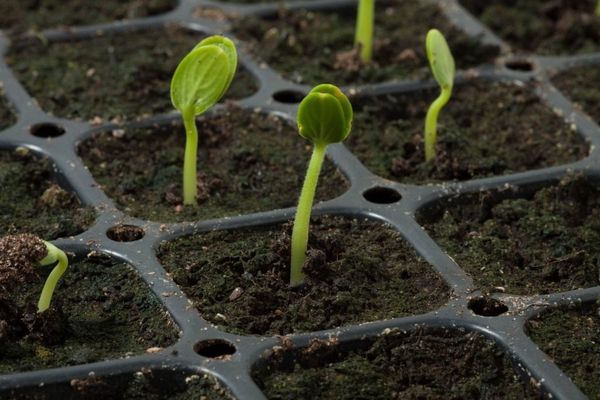
Place the cups on a windowsill in a room with a temperature no higher than 22 degrees Celsius (72 degrees Fahrenheit). Monitor the seedlings constantly. Remove weak shoots after 5–7 days. A week and a half after germination, you can feed the seedlings. Dissolve mullein, superphosphate, and ammonium nitrate in water and water the plants carefully. Avoid getting the solution on the leaves.
Before planting watermelons outdoors, stop watering for 3 days and lower the room temperature so that the plant is prepared for the stressful situation.
Growing from seeds
In southern regions, watermelons are planted in open ground using seeds. How do you plant watermelons this way, and when is it usually sown? Pre-prepared, high-quality seeds are planted 10 cm deep in the soil. The soil temperature should be at least 14 degrees Celsius (55 degrees Fahrenheit) when planting. When planting watermelons, pay attention to the soil texture. If the soil is sandy, the seeds can be planted 8–10 cm deep, while if the soil is hard, the depth should be 4–6 cm.
To grow a watermelon, prepare the soil: mix the topsoil with humus and ash and fill the hole. Level the soil and water it. It's recommended to plant at least five seeds per hole. This doesn't mean you'll grow five watermelons from one hole. You'll just want to leave the strongest seedling there over time.
Planting in open ground
Once you see that the seedlings have grown strong, the young plants can be transplanted into open ground. The first step when planting watermelons outdoors is choosing a site. A well-lit, wind-free area is best. If the site is windy, you can plant the watermelons behind a corn "fence." Then, prepare the soil for the new plant by using organic fertilizer.
People often ask how far apart watermelons should be planted. The following guidelines recommend spacing them at least one meter apart. They are usually planted in a staggered pattern—the standard watermelon planting pattern. Place the seedlings in the holes and compact them with soil, leaving the shoots and leaves exposed. Once all the plants are planted, water each one thoroughly.
Planting and care in open ground include simple but basic steps:
- periodic weeding and loosening of the soil around the foundation;
- regular watering;
- pinching shoots;
- weed removal;
- fertilization with organic matter added to superphosphate and calcium chloride;
- treatment against diseases and pests.
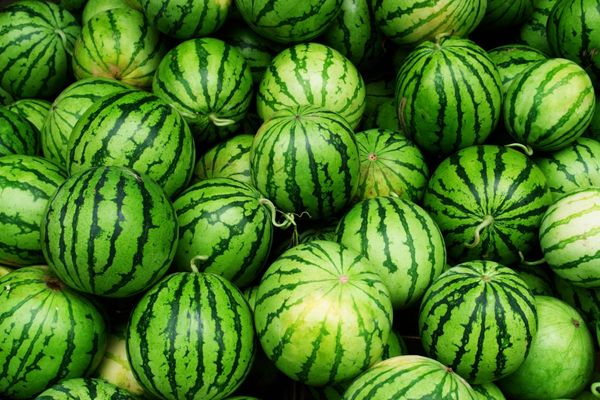
Storing and transporting your harvested crop also requires proper care, regardless of the volume. First, you need to understand how resilient your variety is to transport and storage. Second, you should prepare a dedicated space for your watermelon. The room should have a temperature of up to 5°C (41°F), a humidity of 70–80%, and good ventilation. Line the bottom with dry moss or sawdust. Constantly monitor your watermelons for their condition.
Planting in a greenhouse
What's the proper way to plant a watermelon indoors in a cold climate? It can be grown in a greenhouse without any problems. But the question then becomes: how do you plant a watermelon in a greenhouse?

Here's how to properly plant and care for watermelons:
- The seeds are planted in containers until the sprouts emerge. Special soil for watermelons can be used.
- The soil for transplanting is prepared in a well-known way - by adding organic fertilizers to the soil.
- Seedlings are placed into holes at a distance of 70–80 cm.
- Keep a couple of bees in your greenhouse for better pollination.
- Trim off excess shoots.
- Fertilize with cow dung or liquid manure.
- July-August is harvest time.
Video: How to Grow Watermelons
This video will show you how to grow watermelons properly.