
How to test a watermelon for nitrates at home
Content
Why are nitrates dangerous?
Nitrates are substances widely used in agriculture, primarily found in fertilizers. Strictly speaking, there are no products that are completely free of them. In small quantities, they pose no danger to humans, but at high levels, they pose a threat to consumers.

Nitrates themselves are not dangerous, but when they enter the gastrointestinal tract, they turn into nitrites, which are very dangerous for our body. These are nitric acid salts that can cause oxygen starvation in our body's tissues. They can also trigger thyroid problems or cause food poisoning (diarrhea can be a direct consequence of consuming foods high in these substances).
Verification methods
So, how do you test a watermelon for nitrates? There are several ways to do this. You can do the test in a laboratory using specialized equipment, or you can try to determine for yourself whether the nitrate levels in the berries exceed the acceptable level.
A special device called a nitratometer can be used to accurately determine the levels of these substances in a product. However, despite its high efficiency, it is quite expensive. Therefore, some folk remedies can also be used, which are also quite effective.
The question "how to test a watermelon for nitrates at home" gets different answers, as there are indeed many methods. The first (and simplest) is to place the berry in a container of water. If it floats, it's a very good, high-quality watermelon, but if it sinks, it contains a very high level of nitrates.
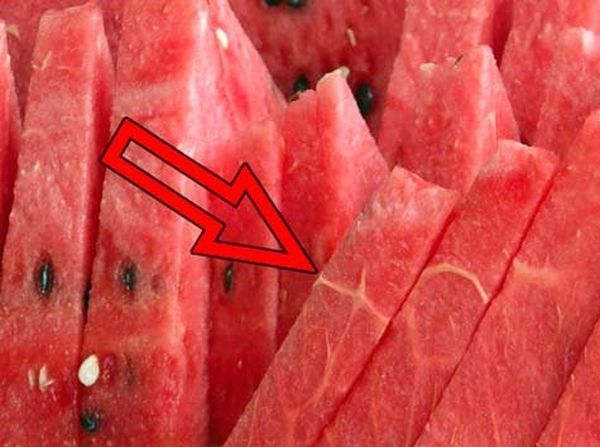
In addition, the presence of white veins on the pulp of the berry also indicates a high content of these substances.
Another way to identify watermelon with nitrates is to cut a slice and place it in a bowl filled with water. If after ten minutes the water becomes slightly cloudy and takes on a pinkish tint, everything is fine.
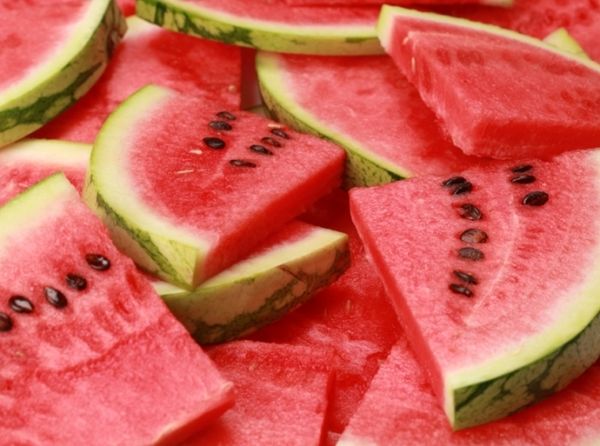
But if it has changed color to bright pink (or even slightly purple), it should be discarded immediately. Also, remember to thoroughly wash the berry before eating, and remember that nitrates typically accumulate in the skin. Therefore, when eating the fruit, avoid eating it right down to the rind—this can lead to unpleasant consequences.
How to choose a watermelon
Above, we described methods that will help you identify high levels of toxic substances in a berry once it's on your table. However, you can also try this before purchasing it to ensure you're bringing home a healthy and delicious watermelon.
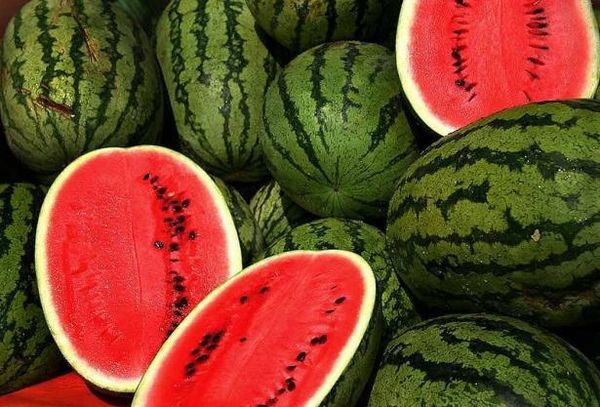
How can you tell a good-quality watermelon from a bad one? The signs of healthy fruit are as follows: first, the stem should be dry; second, the striped pattern covering the surface of the watermelon should be clearly visible; third, a small spot of soil may be visible on the side of the berry. Furthermore, the surface of the fruit should be shiny and free of any matte coating.
In addition, you should only purchase these products from trusted sources, such as specialized markets or stores, to be sure of the berries' quality. First and foremost, pay attention to how they're stored. They should be placed in clean boxes, not left lying around on a dirty floor. It's also important that the berries are whole—buying a cracked or bruised one poses a significant risk. Healthy watermelons also have a distinct, hollow sound when tapped. Ripe berries are quite large (for their variety, of course), but don't weigh very heavily.
Avoid buying berries that are too early. By mid-July, there's a high risk of buying nitrate-rich fruits. However, if you buy them as early as mid-August or even September, you won't even have to worry about harmful substances. Reputable sellers will always be able to provide you with documentation confirming the quality of their products, so don't hesitate to ask about them. They can also cut off a small piece of watermelon for you to try. A good watermelon will have grainy flesh (however, excessively grainy flesh indicates overripeness), and when cut, you'll see white fibers.
If the fibers have a yellowish tint, this indicates that the fruit likely contains nitrates. A normal watermelon has pink flesh, so if the product you're being offered has bright red flesh, there are only a few possible causes. Either it's a specific variety that produces such a bright color (in which case, it's best to check where the product was sourced), or (and this is far more likely) the product being offered contains a truly significant amount of nitrates. Never hesitate to ask the seller questions, as your health depends on the quality of their product.
Video: "Testing Watermelon for Nitrates at Home"
This video will show you how to test a watermelon for nitrates at home.