
Advantages of the mid-early cherry plum variety Kubanskaya Kometa
Content
History of selection and description
The Kuban variety originated at the Crimean Experimental Breeding Station of the All-Russian Research Institute of Plant Growing, named after N. I. Vavilov. Specialists S. N. Zabrodina and G. V. Eremin successfully crossed well-known Vavilov plum varieties with the Pionerskaya cherry plum. By 1977, the new variety was submitted to state testing. Ten years later, it was added to the state register.
The Kubanskaya Kometa cherry plum is undemanding regarding soil conditions, has high regenerative properties, and adapts well to its growing region. It is frost-hardy, easily tolerating temperatures down to -30°C. However, the flower buds are less frost-resistant, but even if they partially freeze, there's no need to worry about the harvest. The plant has average drought tolerance.
The yield rate is high. In practice, the average yield can be up to 10 kg from each tree (the maximum yield was about 50 kg). Fruiting occurs annually. The Kubanskaya Kometa cherry plum variety is immune to common diseases. The fruits are resistant to cracking and, even when overripe, hang on the branches for a long time. They can be stored in the refrigerator for up to 25 days and retain their quality during transportation.
Video: Planting and Fertilizing Cherry Plum
This video will show you how to properly care for cherry plums in your garden, plant them, and feed them.
Characteristics of the tree and fruits
The plant's appearance and its fruits are also interesting. The cherry plum, with the curious name "Kuban Comet," is a low-growing tree no more than 3 meters tall, more resembling a shrub. The crown is moderately dense and flattened. The trunk is covered with gray bark with a few lenticels. The shoots are medium-sized and horizontal. The leaves are also small and elliptical, colored green. The petioles are medium in thickness and length, with an anthocyanin color. The flower buds are medium in size. The white petals are obovate. The peduncle can reach up to 1.4 cm in length.
The average weight of a berry is up to 30 g, individual specimens – up to 45 g.
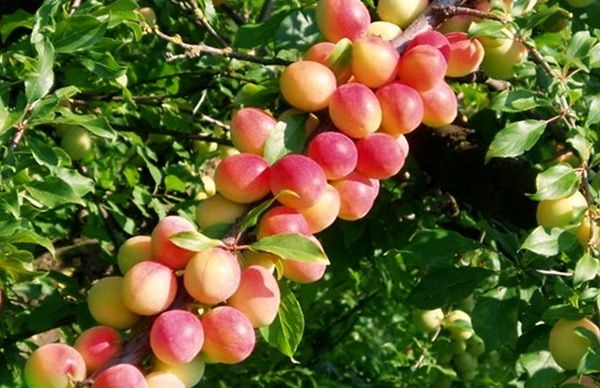
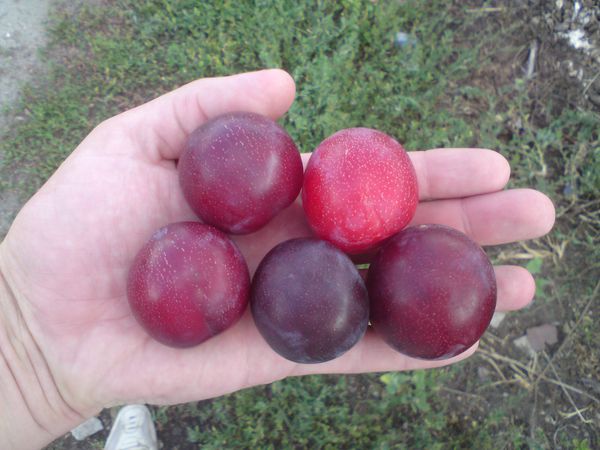
The fruits are asymmetrical, round-ovoid. The berries are initially covered with a yellow-red skin, which later turns burgundy. The stalks are quite thick and firmly attached to the fruit. The seed accounts for approximately 4.2% of the berry's total weight. The flesh is yellow, reddish near the skin, fibrous, medium-dense, and juicy.
The fruit has a sweet and sour taste, with a characteristic apricot flavor. The fruit contains 12% dry matter and 7.7% sugars (of which about 3% is sucrose and 4.7% is monosucrose). It also contains about 1.7% free acids, 0.5% pectin, 0.4% polyphenols, 17.3 mg/100 g of flavonols, 18.8 mg/100 g of anthocyanins, and 95 mg of catechins. The berries also contain beneficial ascorbic acid, with a ratio of 5.8 mg/100 g.
Ripening time
The Kuban Comet cultivar begins bearing fruit 2-3 years after planting. Flowering typically occurs in late April. Fruiting should be expected in mid-July to early August. Gardeners should also plan to harvest during this period.
To accommodate cultivation in various regions, two varieties were developed—late and early. The first is suitable for northern regions, with its fruit ripening in late August. The second is intended for southern regions, with berries available as early as mid-July.
Features of cultivation and pollination
When purchasing seedlings of this plant, choose two-year-old plants with a closed root system, approximately 1.2 m tall, with swollen buds, a yellow-green cut surface, and no damage. Planting is preferred in fertile, sandy soil with a neutral pH. Although this variety is partially self-fertile, a pollinator would be helpful to increase the yield.
When planting several plants in a garden plot, leave a distance of up to 3.5 meters between them. Among the most suitable pollinators for the Kubanskaya Kometa cherry plum are the varieties 'Podarok Sankt-Peterburgu,' 'Puteshestvennitsa,' 'Pchelnikovskaya,' as well as 'Mara,' 'Pramen,' and 'Seyanets.' Other recommended nearby plum trees are 'Skoroplodnaya,' 'Krasny Shar,' and 'Orlovsky Suvenir.'
Watering should be done in June and July, and then only in September. Up to four buckets of water should be poured under the plant. Young seedlings require more frequent watering. Since potassium sulfate, humus, and superphosphate have already been added to the planting hole, the next fertilizer application should be done a year later – in the spring before flowering. After that, the young tree needs to be fertilized up to four times per season. Nitrogen is applied in the spring; a potassium-phosphorus fertilizer is needed after flowering, and potassium sulfate is used after fruiting.
Before winter, the soil should be mulched with humus or compost. Gardeners should prune the crown in the spring and shape it into a bowl-shaped or flat shape annually until the tree reaches three years of age. In the fall, perform a sanitary pruning of the crown. To prevent pests, treat the plants with insecticides—such as Verin and Nitrafen.
To prevent diseases such as brown spot and rust, collect and burn fallen leaves in the fall. To prevent gray mold, spray with Bordeaux mixture and treat with copper sulfate.
Pros and cons
The advantages of this fruit crop include early maturity, partial self-fertility, good winter hardiness, high disease immunity, and abundant harvests. It also produces large, tasty fruits with excellent appearance and flavor.
The disadvantages include poor separation of the pit from the pulp, uneven ripening of the berries, and a decrease in the size of the fruit if the trees are overloaded.